Monday, 4 August 2014

Chelsea Physic Garden (Part 2)

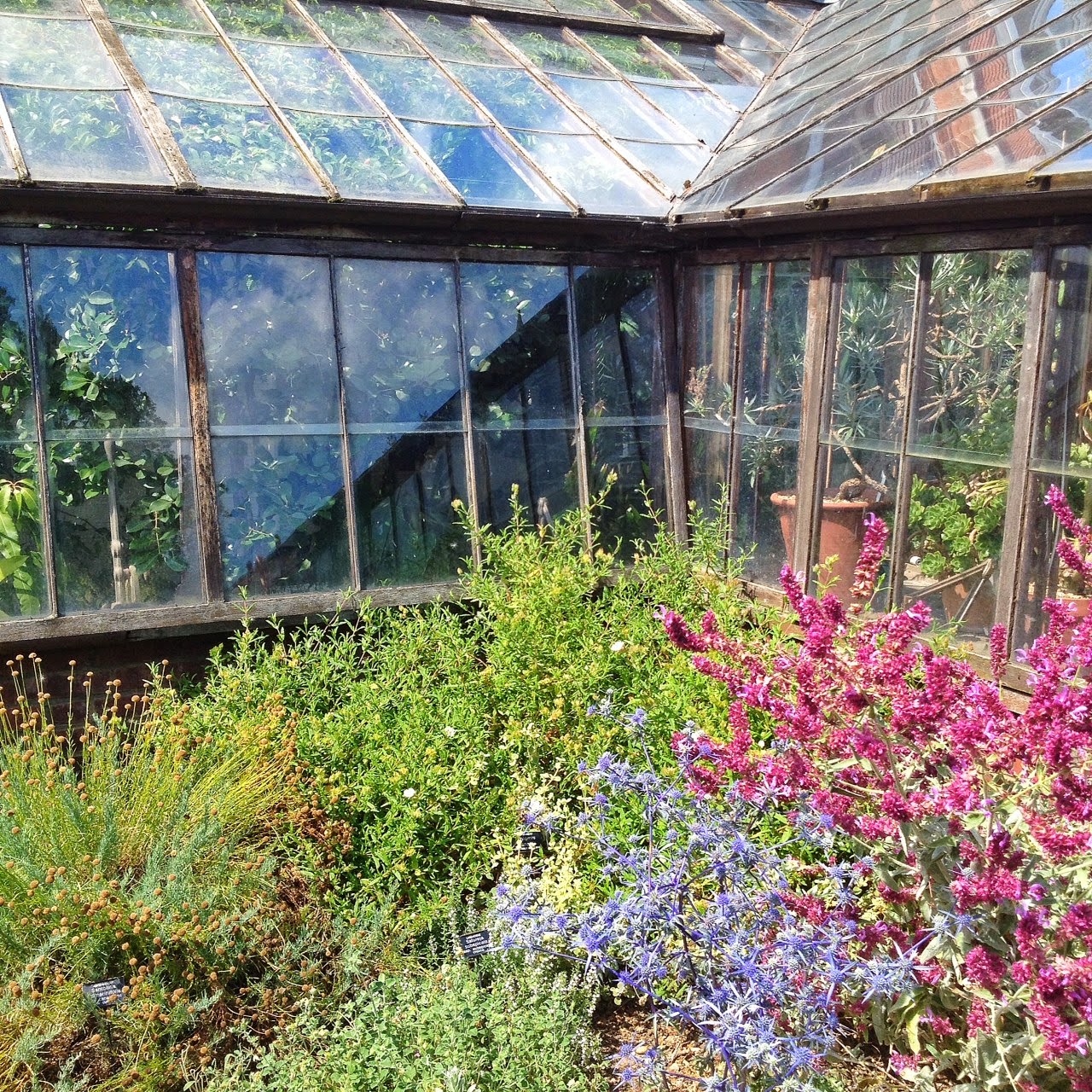
The indoor growing areas at Chelsea Physic Garden may just be my favourite part. I have a particular fondness for ferns, succulents and tropical plants, all of which are heavily represented in the lovely old hot and cool greenhouses in the garden. 


Tropical Hothouse at the Chelsea Physic Garden

The Tropical Corridor covers the north area of the garden. A series of hothouses are filled with exotic and more familiar species - one is rammed to the rafters with Pelargoniums. Unfortunately a large portion of this area was closed to the public during my visit - they had been recently sprayed (happily, with Pyrethrum - an organic insecticide). I had a few tantalising glimpses through the glass at some of the wonders within, and plan to return soon to explore more properly. An all time favourite of mine is Agapanthus, whose sky blue blooms appear throughout this area. Gorgeous. 


Tropical Hothouse with Agapanthus at the Chelsea Physic Garden


Pelargonium at the Chelsea Physic Garden


Succulents in a Hothouse at the Chelsea Physic Garden

Not strictly an indoor zone, but on the same general theme is this theatre of Chillies. Traditionally used to display Auriculas at the height of their Spring glory, these garden 'theatres' work well with other small potted plants, and Chillies look wonderful in this one. It's fascinating to see so many together and compare not just the multicoloured fruits but the varied structures and leaves.


Chilli Theatre at the Chelsea Physic Garden

The Fernery at Chelsea is the first I've ever seen. The white walls and black floor provide a perfect foil to the deep pure greens of the ferns. It's a tranquil spot tucked away against the western wall of the garden. The greenhouse is simply planted with ferns of many types and sizes, with sunken rocks jutting and patches of moss sprawling through the beds. Shady and cool, it is protected to one side by an adjoining building, with window nets blocking the glare of the sun. 


Fernery at Chelsea Physic Garden


Fernery close up at the Chelsea Physic Garden

There's something a bit special about the shape of ferns. The elegant bend of the lilting fronds, the violin scrolls as they unfurl, the airy lightness of the small, perfectly arranged leaves diminishing to a fishbone point. Apparently there is a word for the fern-obsessed: 'Pteridomaniac'. Good to know.

Much as I love colour, and colourful plants, the total and utter greenness of the Fernery is just beautiful. From the dark foresty greens of the mosses, to the pale spring hues of the delicate Maidenhair ferns. Chunks of wood hung on the wall host more specimens, and lend a slightly surreal sense to the space. Botanical hunting trophies of days gone by. 


Fern log at Chelsea Physic Garden


Maidenhair Fern at the Chelsea Physic Garden


Fernery at the Chelsea Physic Garden


Fern close up at the Chelsea Physic Garden


The snaky stripes of Horsetail rear high in a far corner of the greenhouse. They encompass a range of shades - from near black, to bright lime and a practically fluorescent yellow. These strong smooth stems, with their bamboo style joints, do not actually belong to the Fern family, but are the last remaining genus of the vascular family Equisetaceae, which were prolific in the forests of the Paleozoic era, over 500 million years ago. Living fossils!


Horsetail at the Chelsea Physic Garden


Horsetail at the Chelsea Physic Garden

The Wardian case, nestled at one end of the Fernery, creates an enclosed atmosphere to provide a constant high humidity. The filmy ferns within have fronds just one cell thick, and are naturally found near waterfalls. The case was designed to aid transportation of delicate plants, previously at risk from exposure on long journeys across the seas. It was designed by the fern-loving Dr. Ward, who wrote the imaginatively titled book 'On the Growth of Plants in Closely Glazed Cases.' The mist and blurriness of the case did not lend itself to photographing, but you get the general idea. 


Wardian Case at the Chelsea Physic Garden

The final indoor area at Chelsea is a small glasshouse attached to the main building, housing an incredible collection of Cacti and Succulents, and a tabletop display of carnivorous plants that is like a little prehistoric world all of its own. 


Carnivorous Plants at the Chelsea Physic Garden


Carnivorous Table Top at the Chelsea Physic Garden

The glasshouse really is a tiny space, but might just have be the highest plant to space ratio of the whole garden - look at them crammed in there! 


Cacti at the Chelsea Physic Garden

I find the graphic shapes of cacti and succulents very appealing. The geometric precision of forms and Fibonacci-esque  patterns are just mindblowing. There's also something very humble and friendly about them - they're stunning but they don't shout about it. If I could pick up that little greenhouse and take it home, I would.


Succulents at the Chelsea Physic Garden


Chelsea Physic Garden is situated on the northern bank of the Thames at Chelsea, and can be accessed from Swan Walk, to the East. The nearest tube is Sloane Square. At the time of my visit, the entrance fee was £9.90. The Garden is run as an independent charity.


Thursday, 31 July 2014

Chelsea Physic Garden (Part 1)

I finally visited Chelsea Physic Garden last week, on an absolute scorcher of a day. An incredible variety of plants thrive in its 3.8 acres, a secret walled garden in the heart of the city. Themed areas, utterly different in mood and aesthetic, are cleverly arranged - you can lose yourself for hours wandering, looking, smelling and dreaming.


Thistle and blue sky at the Chelsea Physic Garden


Flowering Climber at the Chelsea Physic Garden


Propagation Area at the Chelsea Physic Garden

I ended up with a lot of photographs from my visit. Literally hundreds. Everywhere I looked there was something beautiful or interesting. It has been hard to edit these down into a manageable number for just one post so I have decided to split my visit across two posts, the second of which will cover the indoor growing spaces - the tropical Hothouses, cool Fernery, and a small greenhouse filled with cacti, succulents and carnivorous plants. For now, I will focus on the abounding wonders of the outdoor spaces of the garden...

Chelsea Physic Garden was founded in 1673 by the Society of Apothecaries, as a space for apprentices to grow and study medicinal plants in. The site already contained established orchards and market gardens, with a free draining soil and southerly aspect ideal for the many specimens that would arrive from warmer climates to be planted into the collection.


Bamboo at the Chelsea Physic Garden


Tropical corridor at the Chelsea Physic Garden

Hundreds of years of considered planting and botanical experimentation have created a unique and fascinating space, with support and contributions from a series of explorers, botanists and gardeners. A statue of Sir Hans Sloane stands at the centre of the garden. Hans bought the 'Manor of Chelsea' (land that included the garden) in 1712. He proceeded to grant a perpetual lease of the garden to the apothecaries, at a rate of £5 per year. This fee is apparently paid to his descendants to this day!


Hans Sloane Statue at the Chelsea Physic Garden

Paths radiating from Hans's statue lead to areas of specific focus, ordered with a view to education, research and conservation. Which all sounds fairly clinical, but in the height of summer feels quite the opposite, with plants blooming, arching and spilling across the neatly edged beds, a complex symphony of colour and form.

The Dicotyledon Order beds are laid out to indicate the relationship between species, with an evolutionary sequencing. A particular favourite here was a dense mass of white poppies, with a more than a little of the poached-egg about them (I may have just been hungry...)

White Poppies at the Chelsea Physic Garden


Pink Flower at the Chelsea Physic Garden


Clematis bush at the Chelsea physic Garden
   
The Monocotyledon Order beds are currently a little sparse, due to a recent fallow period imposed to combat a serious weed problem. The planting here is designed to reflect the 'natural' style of classification preferred by John Lindley - an eminent botanist and Head Gardener at Chelsea 1836-53.

The Garden of Medicinal Plants is lush, filled with the familiar and the unusual, in a series of interlinked courtyards. Subtle signage describes the ways in which the plants can be used. Though all the plants have been carefully chosen, some parts feel almost wild, with naturalistic planting and a casual abundance.


 Medicinal Plants at the Chelsea Physic Garden


 Cow Parsley at the Chelsea Physic Garden


Ivy Urn at the Chelsea Physic Garden

The Garden of Edible Plants is a small but lovely section, encompassing herbs, fruits and vegetables. As you'd expect, there is a lot of crossover here with other areas. I wonder if (and hope that) the produce here is used in the onsite cafe.


Raised Beds at the Chelsea Physic Garden


Courtyard, Garden of Edible Plants at the Chelsea Physic Garden


Fortune's Tank Pond t the Chelsea Physic Garden

Fortune's Tank Pond is crammed with reeds and waterlilies, and alive with frogs, dragonflies and more. A planted bank to one side separates it from the formal beds, and cast some shade across the edge of the pond. A body of water makes such a difference to a garden.

The History Beds showcase the many specimens brought to the Garden by botanists through the ages, many of them introduced to England for the first time. William Hudson, Robert Fortune and Sir Joseph Banks are among the luminaries represented here. The men and women who helped to make the garden such an extraordinary place are noted and honoured throughout. One sign describes how Carl von Linne, a Swedish botanist and taxonomist, delighted in the task of naming new specimens. He dubbed the common toad 'Buffo Buffo' after a French rival - Comte de Buffon. Ha!


History Gardens at the Chelsea Physic Garden

The Garden of Useful Plants displays numerous functional species - used for textiles, dyes, hygiene, craft, perfume, fuel... It's important to be reminded just how many elements of our lives depend on plants. The area includes a small but perfectly formed vineyard, a bed displaying plants which have religious symbolism, and even a specimen of Cannabis Sativa. There is something heavily metaphorical and actually a bit moving about the various plants sacred to different religions thriving in a bed together. 


Cannabis Sativa at the Chelsea Physic Garden


Garden of Useful Plants at the Chelsea Physic Garden


Olive Tree at the Chelsea Physic Garden

We ate lunch in the cafe, in view of a huge Magnolia tree. Its flowers were vast and perfect, with a form, solidity and snowy whiteness reminiscent of nothing so much as a starched shirt collar. Unreal. 


Magnolia Flower at the Chelsea Physic Garden

Many beautiful trees, some extremely old, tower amongst the formal beds and cast a deep shade over the woodland areas edging the south side of the garden. These include an ancient yew, the largest outdoor olive tree in the UK, and a stunning weeping beech. The day of my visit was so hot that even with a fair few visitors in the garden, the exposed areas were practically empty of people. Instead respite was sought in the shady woodland, cool and green and alive with birds. 


Lacecap Hydrangea at the Chelsea Physic Garden


Pruned Bx at the Chelsea Physic Garden


 Shady Path at the Chelsea Physic Garden

The woodland area feels semi wild, with naturalistic shrubs and groundcover. There is a wonderful Lacecap Hydrangea, with cucumber colouring and those perfectly 'unfinished' blooms. Anenomes bring a gentle splash of colour, Hostas try and fail to defy hungry slugs, and a slightly anomalous and inexplicably amusing cluster of globe pruned box borders the woodland to the east.

Many of the trees are hung with bee houses, and there are log piles and stumps left to encourage insects. What a wonderful place for them to live!

Bee House at the Chelsea Physic Garden


 Woodland Area at the Chelsea Physic Garden


 Woodland Path at the Chelsea Physic Garden


Chelsea Physic Garden is situated on the northern bank of the Thames at Chelsea, and can be accessed from Swan Walk, to the East. The nearest tube is Sloane Square. At the time of my visit, the entrance fee was £9.90. The Garden is run as an independent charity.


Thursday, 24 July 2014

Still Life City: Building Site


There's a building site to the east of Bishopsgate. Some towering, glittering monstrosity will appear eventually, but in the meantime there were some monochrome gems.

Still Life City: Black & White 1

Still Life City: Black & White 2

Still Life City: Black & White 3


Tuesday, 22 July 2014

Back in the Game

After an 18 month hiatus, I've decided to restart my blog, so - hello!

I'd actually planned to create a new blog, but as the subject matter is not a world apart, and I plan to also update on my own gardening adventures, it made sense to pick up on this one instead, with a new name and adjusted focus.

For those of you who didn't visit beforehand, this blog (the old posts remain below) used to be called the Amateur Balcony (note - I do not recommend googling this phrase - you get some pretty fruity results! Something I had not thought to check out before naming it...). The blog focused on my small London balcony, and my gardening experiments, triumphs, disasters and learning. 

This 2.0 version - Still Life City, will be more a record of the green and growing spaces I visit, the urban beauty I stumble across, and general swashbuckling excitements in the world of plants, growing, urban agriculture, sustainability and regeneration. So - a fairly broad sweep! But within a definite lens. Basically, I'm going to write about the things I love. 

Also, I am in the habit of taking close up photos around the city - of colours, textures, random markings, manmade and natural details, often strange and always beautiful. To my eyes at least. They're like accidental abstract paintings. Still Lifes of the city. In all the glorious, huge and majestic wonder of London, I think there are tiny moments of beauty to be noticed - in even the grubbiest or most banal of places. So, I'm going to post my Still Life City pictures here too. 


Still Life City: Red & Blue (Shoreditch)

Onwards! Until next time. 


Friday, 31 August 2012

Howdy to the herbs

In a year of biblical rains and giant slug attacks, not to mention the standard balcony challenges - wind, dry pots, next doors cat etc - it's been a surprisingly stellar year for my herbs. I pretty much doubled the herbage this year - to my old staples of Garden Mint, Rosemary, Thyme and Parsley I added a motley crew of impulse buys and sought-for finds. From the humble to the mighty, they have plugged gaps and stolen spotlights all over the place. I thought I'd introduce some particular favourites. (Prepare yourself. This is going to get WILD.)


First up - the Greek Basil. A plump little bush of tiny tasty leaves that have graced many a salad this summer. The truest, cleanest green of perhaps all my plants. It is radiant with health (has been since arrival), blossomed with no loss to flavour, and is a cheery and welcome addition to life in general. Greek Basil, I salute you. 


Tarragon was a bit of a wildcard - the last of 6 baby herbs I bought in June. It was some kind of a deal if you buy 6, so I had maybe 4 definites, and was musing on the final few to fill the quota. This snuck in. I thought it would be a useful herb, and though I haven't cooked with it yet, I've enjoyed watching it grow. Well, 'recover' may be more accurate. I can be a bit naughty with delaying the potting up of new plants, and this was a casualty of my laziness. Almost fatally so. In the months since I finally bedded it down, it has gone from a small frail and somewhat crispy little runt to a happy frothing tumble. Phew. Now I just need to start cooking with it. 


The Vietnamese Coriander has grown an incredible amount. Tenfold at least! I absolutely love its shape, structure, leaf pattern - everything! I have in fact become obsessed with it, singing it's virtues to all who'll listen, and many who'd probably rather not... It may win the accolade of my favourite new plant. It's really that good. And just look at it's swampy sprawl! Another massive bonus is the ease with which it takes root - you literally just cut a chunk off and chuck it in a glass of water. In days you'll have roots...


Vietnamese Coriander is also known as 'hot mint' which is a fairly good (but not all-encompassing) description of it's flavour. Last night I made a very plain asian veg broth for my (dieting) sister, and a sprinkle of this added incredible freshness and punch. Highly highly recommended. 


A final mention goes to this Basil. Run of the mill Italian Basil. The likes of which grace most every kitchen windowsill in town. Usually half dead. These particular badboys were bought in a supermarket in February. That is to say, six long months ago. And still they thrive! I kept them inside for a while but they got pretty buggy, so I potted them on (easing apart the individual stems for some breathing space) and put them outside. They have beaten my previous record for keeping supermarket herbs alive by approximately five and a half months. Fine work boys. 

Apologies to those left unmentioned. Your time will come.


Friday, 27 July 2012

The 30 Year Old Intern

Not a bad film title, my new job situation... I have been slack with posting recently. Really need to stop writing epic posts and get into a little-and-often habit with the old blogging, methinks. Heyho. But, have been incredibly busy these last couple of weeks as I have started an internship with the amazing FARM: project, based at FARM:shop in Dalston.

This might be a slight deviation from my usual balcony-centric blather, but hopefully that will be a refreshing change for you devoted readers. (All 3 of you)


(FARM:shop - A farm, in a shop!)

So, the long and the short of it is - having become more and more interested in growing plants and food these last few years, I was starting to wonder about making a serious career change in that direction. When the charity I worked for went belly up at the end of May, It seemed as good a time as any to make a change. Though I have useful and transferable professional experience, none of it is in the world of growing. As well as continuing to develop my balcony, and possibly start an evening/correspondence horticulture course (any recommendations? RHS level 2 maybe?) I wanted to find voluntary work with a project, preferably an urban agriculture one, to learn more about the technical side of things, and generally get a foot into the door of that world...  I'm not really a believer in fate but sometimes things do seem to happen at the right time, and chances arise just when you really need them.

When I saw that FARM: were recruiting for an intern, it seemed like the most incredible opportunity. Though there are lots of city farms and brilliant veg growing projects in London, I was particularly excited by FARM: because of their experimental approach, the aesthetic element of their work, and the fact that their project is so completely different from the others. (And they have chickens on their roof! To be honest, that's what tipped the scales...) As well as traditional growing, they work with hydroponic and aquaponic systems, which has been fascinating to learn about. I have literally learnt more in one week with them than I have in full years with other jobs. It's amazing how easy it is to learn about something when you find it so interesting.

A very cool external project I'm working on for them is maintaining their 'FARM:wall', installed at Hackney House (a summer pop up venue on Shoreditch High St). It consists of 3 caged hydroponic wall systems, growing basil (Thai and Genovese) and rainbow chard. I think they look amazing! 


In the same area as the FARM:wall (an open-air section at the front of the venue) is a 'Lily Vanilli' cake and coffee concession. If you haven't had the pleasure, Lily makes the most ridiculously delicious cakes in her bakery on Columbia Rd. This week I have helped to design and build an 'edible wall' for her. Contrary to my slightly panicky/paranoid expectations, the finished thing is a dead ringer for my design drawing. Very satisfying!


I realise this whole post sounds a bit like an advertorial for FARM: (what can I say, I'm loving working there!), but needless to say, FARM:shop is well worth worth a visit if you're in the area. They have a cafe serving up produce grown on site, and you can eat in the garden (or polytunnel if its rainy!). You might even stumble across me, propagating basil for a hydroponic wall, cropping fresh salads from the garden, or clucking at the chickens.

I really am having the most absolutely brilliant time in my internship. No doubt I'll be writing a lot more about it all...

Monday, 2 July 2012

Tinned geraniums and a box full of beans

It's been a hectic couple of weeks on the balcony. I recently went on a Capital Growth course specifically about growing in containers - it was fantastic, and left me full of ideas and excitement. (I know, I know, I'm a massive geek). Everyone there was a Londoner, growing mainly food, often in small or awkward spaces. It's so exciting to see how many people are doing this, it really does feel like a snowballing thing. 

We got some great advice from a fellow student on the course. She volunteers with Food from the Sky (a permaculture growing project on a supermarket roof in North London) and said that all of their growing containers are old recycling boxes from Haringey council. Lucky for me, my mum lives in Haringey, so I was able to thieve a couple of her old boxes to repurpose.


This one is full of runner beans (I really loved making a bamboo frame for them! Something incredibly satisfying about it. Can't wait for them to start climbing and twining up it.) The boxes are a great size, big enough to fit lots in, and deep enough for serious rooters. Another consideration is that I'm fast running out of space on the balcony, so using square sided containers rather than round ones is a good idea. Not to mention the fact that they're free. I'm hoping to obtain a few more. Perhaps some nocturnal scavenging round the streets of Haringey is in order...

I also picked up some pallets locally - one of the many great things about east London is the amount of useful things left out on the street. They're perfect for gardening purposes, solid and durable. As well as boosting the height and therefore the light available to the plants, the pallets lend a sense of structure to the space - I much prefer having a group of pots on a pallet than just hanging out on the floor.

On the theme of freebies, I've made some planters out of old double-size tins (in this case, chickpeas, fresh from feeding my hummus addiction).


A few drainage holes in the bottom and it was good to go. Although for the next ones (I'm saving all my old tins now) I'll line it with something to insulate the roots - apparently (and logically) they scorch a bit otherwise. This trailing geranium seems happy enough though. Probably because we've had so little sun!

Along with the tinned geraniums, and box of beans, other recent additions are an aubergine plant, courgette, peppers and more tomatoes. I've also gone a bit crazy with new seeds, so will be sowing pak choi, kale, and - after the current ones so rudely bolted the other week, more perpetual spinach.

A final mention on this accidentally but seemingly recession-themed post has to go to the nice folks at Alara. They have decided to use a bit of land in front of their muesli factory used as a municipal compost pick up. It's free! I went and filled up 3 huge bags of lush, dark, still-warm compost from them.  Absolutely brilliant. 

Our trainer on the Capital Growth course, Tom Moggach, had some interesting things to say about the ever-increasing commercialisation of gardening, and the fact that we really really don't have to buy into it.  Most of the necessities can be found for free, if you look hard enough, and seeds and cuttings can be shared between gardeners. A true and timely point.

Onwards! To more growing and less spending.